JavaScript Frameworks for Progressive Web Apps: A 2026 Guide
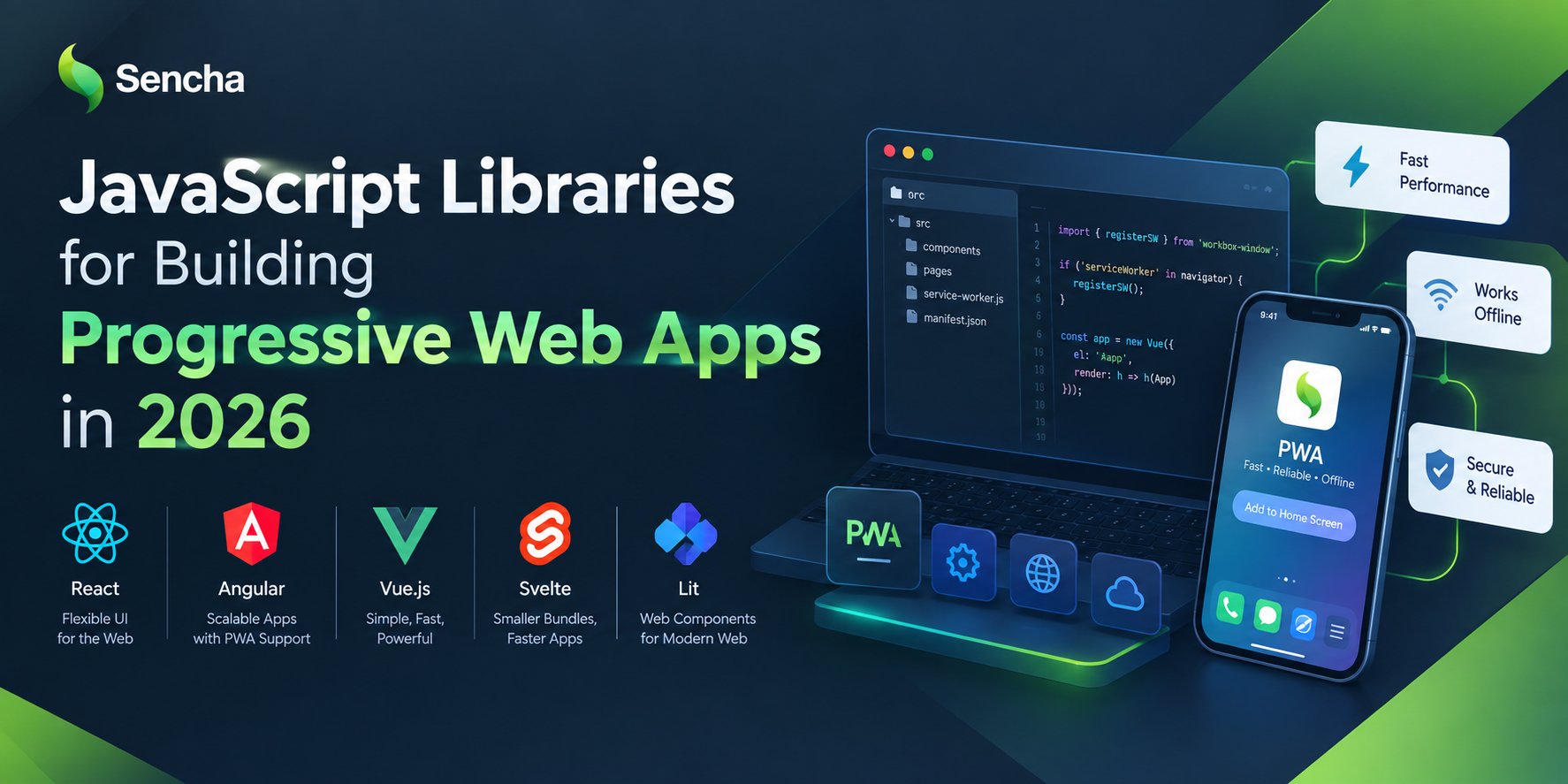
Progressive Web Apps combine the reach of the web with many capabilities traditionally associated with installed applications.
A PWA can use service workers, caching, web app manifests, responsive interfaces, and other browser capabilities to create a fast and reliable application experience.
But the JavaScript frameworkwork you choose still matters.
Different frameworks solve different problems, and the right choice depends on whether you're building a content-focused application, a consumer product, or a complex enterprise system.
What Makes a Good PWA?
A modern PWA typically needs:
Responsive design
Fast loading
Reliable network behavior
Offline or limited-connectivity support where appropriate
Installability
Secure HTTPS delivery
Efficient data management
Accessible UI
The framework should support these requirements rather than becoming an obstacle to them.
Ext JS for Data-Heavy PWAs
Ext JS is particularly suited to PWAs that function as enterprise business applications.
It includes 140+ pre-built components, including:
Advanced data grids
Pivot grids
Charts
Forms
Trees
Calendars
Layouts
Data stores
This is useful when users spend most of their time interacting with business data rather than consuming content.
For example, an enterprise PWA might need a dashboard containing a large data grid, multiple charts, filtering controls, editable records, and complex forms.
With a comprehensive framework such as Ext JS, many of these capabilities are already part of the framework.
React for Flexible PWA Development
React's biggest advantage is flexibility.
Developers can combine React with different libraries for routing, state management, data fetching, service workers, and UI components.
This makes React a strong choice for teams that want to assemble their own architecture.
The downside is that teams need to make more decisions about which libraries to use and how those libraries work together.
Angular for Structured Applications
Angular provides a more opinionated development model.
Its TypeScript-first architecture, dependency injection, routing, forms, HTTP functionality, and CLI make it attractive for larger development teams.
Angular is particularly useful when consistency across multiple teams is more important than having maximum architectural flexibility.
Vue for Approachable Development
Vue provides a relatively straightforward entry point into component-based development.
Its ecosystem supports routing, state management, and PWA development.
It can work well for teams that want modern frontend architecture without adopting a highly opinionated framework.
Service Workers
Service workers are one of the key technologies behind PWAs.
They can intercept network requests and implement different caching strategies.
For example:
self.addEventListener("fetch", event => {
  event.respondWith(
    caches.match(event.request)
      .then(response => response || fetch(event.request))
  );
});
The exact caching strategy should depend on the resource.
Static assets might work well with cache-first behavior, while frequently changing API data may require a network-first strategy.
Web App Manifest
The manifest provides information about how an application should behave when installed.
A basic manifest might contain:
{
  "name": "Enterprise PWA",
  "short_name": "PWA",
  "display": "standalone",
  "start_url": "/",
  "theme_color": "#054059"
}
Icons, orientation, background color, and other properties can also be defined.
Performance Considerations
A PWA can still be slow.
Using a framework doesn't automatically guarantee good performance.
Measure:
JavaScript bundle size
Initial rendering
API response time
Rendering performance
Memory usage
Cache effectiveness
Offline behavior
Large enterprise applications should also be tested with realistic datasets.
An interface that performs well with a few hundred records may need a very different approach when users work with tens of thousands of records.
Which Framework Should You Choose?
There is no universal winner.
Choose Ext JS if:
Your PWA is a complex enterprise application with large datasets, advanced grids, forms, dashboards, and business workflows.
Choose React if:
You want a flexible ecosystem and your team already has React expertise.
Choose Angular if:
Your organization values structure, conventions, and TypeScript-based development.
Choose Vue if:
You want a flexible framework with an approachable learning curve.
Conclusion
Progressive Web Apps remain an effective way to deliver application experiences through the web.
The key is to choose the technology based on the application's actual requirements.
React, Angular, and Vue provide strong options for different development styles, while Ext JS is particularly interesting for enterprise PWAs where data management and sophisticated UI components are central to the application.
The framework is only one part of the equation. Service workers, caching, responsive design, network behavior, security, and performance testing are equally important.
Build around the requirements first, then choose the framework that makes those requirements easier to deliver.