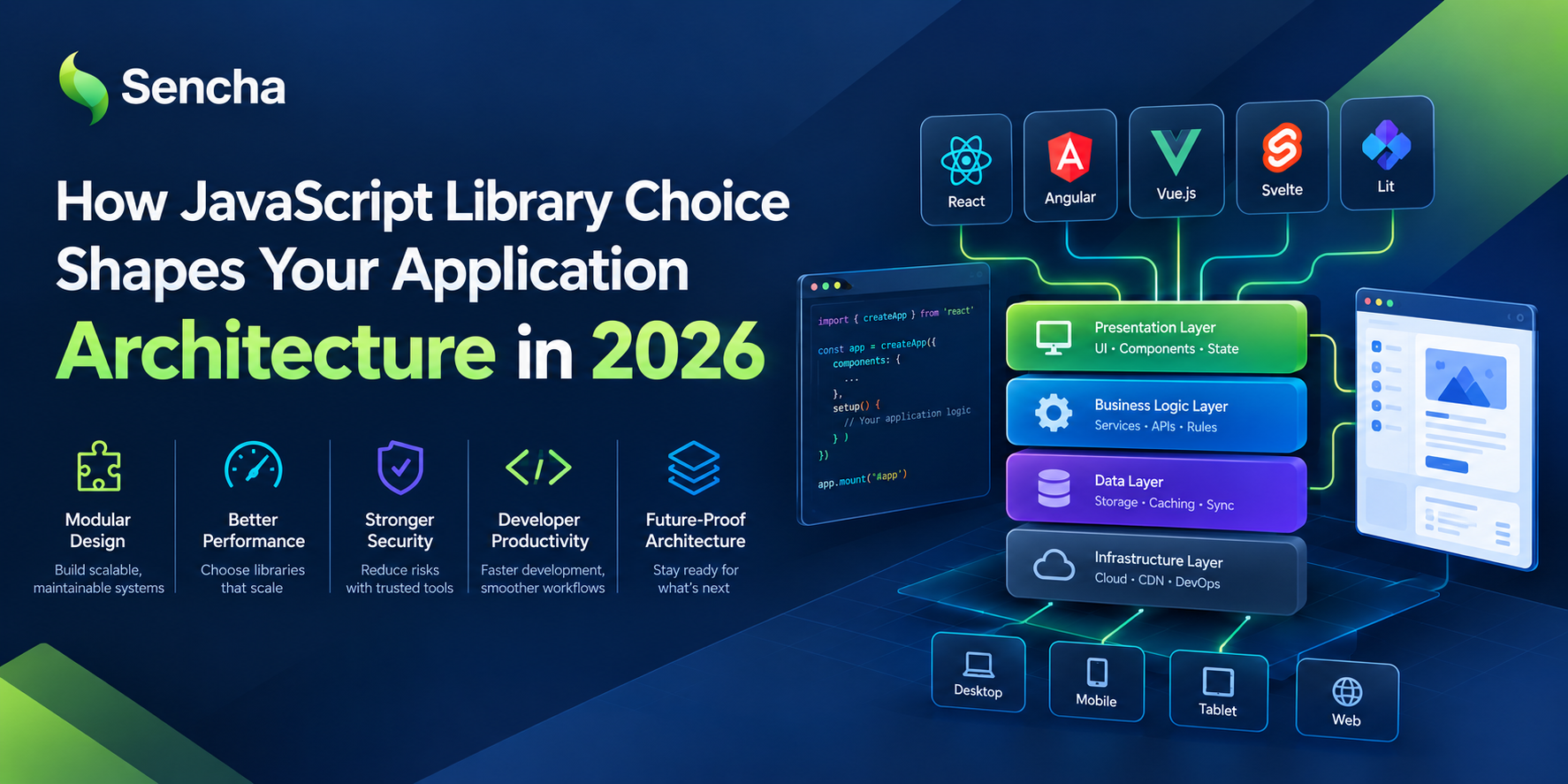
25 Best JavaScript Libraries for Enterprise Development in 2026
Modern enterprise applications depend on more than a frontend framework.
A production application may need advanced UI components, data visualization, state management, API communication, testing, styling, animation, and build tooling. Selecting each library independently can create a flexible stack, but it can also increase maintenance overhead.
This guide covers 25 JavaScript libraries and frameworks across the most common enterprise development requirements.
What Should Enterprise Developers Look For?
Before choosing a library, evaluate:
Performance with realistic datasets Long-term maintenance Browser compatibility TypeScript support Accessibility Documentation Security updates Licensing Integration capabilities Dependency count
A library that performs well in a small demo may not perform well when the application contains hundreds of screens and thousands of users.
UI Frameworks and Component Libraries
- Ext JS
Ext JS is a strong option for enterprise applications with complex interfaces and large amounts of structured data.
It includes more than 140 pre-built components, such as:
Data grids Pivot grids Charts Forms Trees Calendars Layout systems Data stores
Its enterprise-focused component set can reduce the need to assemble multiple third-party libraries.
Best use cases:
Data-heavy dashboards Financial applications Reporting systems Enterprise administration tools Complex business applications
Ext JS is not necessarily the right choice for every project. Content-driven websites and lightweight applications may benefit more from a smaller frontend stack.
- React
React provides a flexible component-based architecture and a large ecosystem.
It is suitable for:
Single-page applications Consumer-facing applications Content-heavy websites Cross-platform development
Teams should plan for additional libraries when they need advanced grids, charts, forms, routing, or state management.
- Angular
Angular provides a structured framework with built-in support for routing, forms, dependency injection, HTTP communication, and TypeScript.
It is a good fit for large teams that need consistent project architecture.
- Vue.js
Vue offers a balanced approach between flexibility and structure.
It is useful for:
Gradual modernization Mid-sized applications Teams transitioning from jQuery Applications with moderate complexity Data Visualization 5. D3.js
D3.js provides low-level control over data-driven visualizations.
It is useful for:
Interactive charts Maps Network diagrams Custom SVG visualizations Complex animations 6. Chart.js
Chart.js is a straightforward option for standard charts.
It supports common chart types such as bar, line, pie, radar, and scatter charts.
- Plotly.js
Plotly.js is suitable for statistical and scientific visualizations.
It supports advanced chart types, including 3D plots, box plots, and violin plots.
Utility Libraries 8. Lodash
Lodash provides utilities for arrays, objects, collections, and transformations.
- Ramda
Ramda focuses on functional programming, currying, and immutable operations.
- Day.js
Day.js is a lightweight date utility library for parsing, formatting, and date arithmetic.
Animation 11. GSAP
GSAP is useful for complex timelines, SVG animation, and advanced motion effects.
- Framer Motion
Framer Motion is designed for declarative animation in React applications.
- Lottie
Lottie allows developers to display animations created in After Effects.
Testing 14. Jest
Jest provides test execution, assertions, mocking, and coverage reporting.
- Cypress
Cypress is useful for browser-based end-to-end testing and debugging.
- Playwright
Playwright supports Chromium, Firefox, and WebKit, making it a strong option for cross-browser automation.
HTTP and State Management 17. Axios
Axios provides request handling, interceptors, automatic transformations, and error management.
For basic HTTP requests, native fetch() may be enough.
- Redux Toolkit
Redux Toolkit simplifies Redux development and includes RTK Query for server communication and caching.
- Zustand
Zustand provides lightweight state management for React without extensive boilerplate.
Form Libraries 20. Formik
Formik manages form state, validation, and submission in React applications.
- React Hook Form
React Hook Form focuses on performance and minimizes unnecessary re-renders.
It is a strong option for large forms and TypeScript projects.
Styling 22. Styled Components
Styled Components provides CSS-in-JS and dynamic styling based on component properties.
- Emotion
Emotion provides flexible CSS-in-JS, theming, and styling capabilities.
Build Tools 24. Webpack
Webpack supports advanced bundling, code splitting, caching, and legacy integrations.
- Vite
Vite offers fast development startup and modern build tooling.
It is a strong choice for new projects that do not require Webpack’s extensive plugin ecosystem.
How to Select the Right Library Define your technical requirements
Start with the actual needs of the application:
How much data will be displayed? Are real-time updates required? Which browsers must be supported? Is accessibility mandatory? Does the application need advanced forms? How complex are the integrations? Benchmark with realistic data
Do not rely only on demo performance. Test with production-like datasets and workflows.
Check maintenance activity
Review:
Release frequency Open issues Security updates Documentation Upgrade history Maintainer responsiveness Evaluate the full dependency footprint
Every dependency adds maintenance and security responsibilities.
A comprehensive framework may reduce the number of separate packages needed for UI components, forms, data handling, and routing.
Review licensing and support
Enterprise projects should consider commercial support, licensing, training, and long-term costs.
Conclusion
JavaScript library selection should be based on technical requirements rather than popularity alone.
React is a flexible option for teams that value ecosystem choice. Angular is useful for structured enterprise development, while Vue is a practical choice for gradual modernization.
D3.js is ideal for custom visualizations. Jest, Cypress, and Playwright cover different testing requirements. Vite is a strong modern build tool, while Webpack remains useful for complex build pipelines.
For enterprise applications that depend on advanced grids, charts, forms, dashboards, and large datasets, Ext JS is worth evaluating because it provides a broad set of integrated enterprise components.
The best JavaScript stack is the one that meets your performance, maintainability, integration, and business requirements over time.