Why Signals Are Reshaping JavaScript Frameworks in 2026

Feels like Signals are becoming one of the biggest architectural shifts happening across modern JavaScript frameworks right now.
For years, frontend frameworks have mostly optimized around component re-rendering and Virtual DOM diffing.
Now the industry is slowly moving toward fine-grained reactivity, where only the exact UI framework dependency updates are made instead of entire component trees.
Frameworks like SolidJS helped popularize this approach, but the influence is spreading everywhere now.
What’s interesting is that this isn’t only about performance anymore.
Signals also improve:
reactive traceability
predictable updates
scalability
AI-assisted development workflows
rendering efficiency
That becomes especially important for enterprise applications with:
dashboards
advanced grids
analytics systems
reporting platforms
large data-heavy interfaces
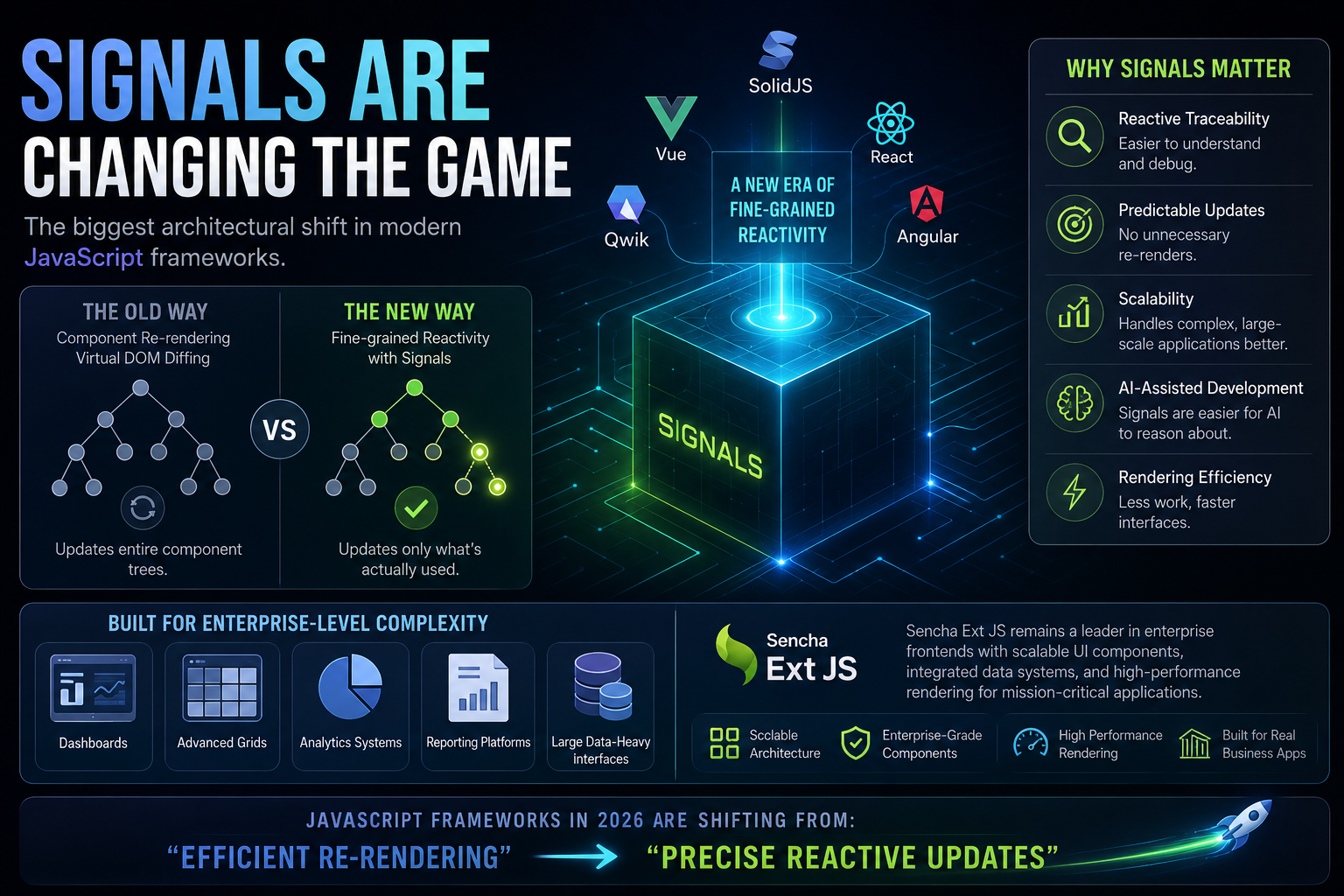
This is honestly why frameworks like Sencha Ext JS still stay relevant in enterprise frontend development. Ext JS focuses heavily on scalable UI systems, integrated enterprise components, and efficient rendering for complex business applications.
Feels like JavaScript frameworks in 2026 are slowly shifting from: “efficient re-rendering” toward: “precise reactive updates.”