Ext JS 8.0: Reduce Frontend Complexity with Built-In Components
Modern frontend development looks powerful on the surface—but under the hood, it’s often messy.
Developers are constantly stitching together multiple libraries just to build a single enterprise application:
UI component libraries
Data grid solutions
Charting tools
Form handlers
QR code generators
Digital signature tools
It works… until it doesn’t.
The Real Problem: Dependency Overload
If you’ve worked on a large-scale application, you already know the pain:Version conflicts between packages
Endless maintenance and updates
Inconsistent UI/UX across modules
Security risks from outdated dependencies
As your app scales, your dependency tree becomes harder to manage—and even harder to trust.
A Better Approach: Built-In Capabilities
This is where Sencha Ext JS 8.0 changes the game.
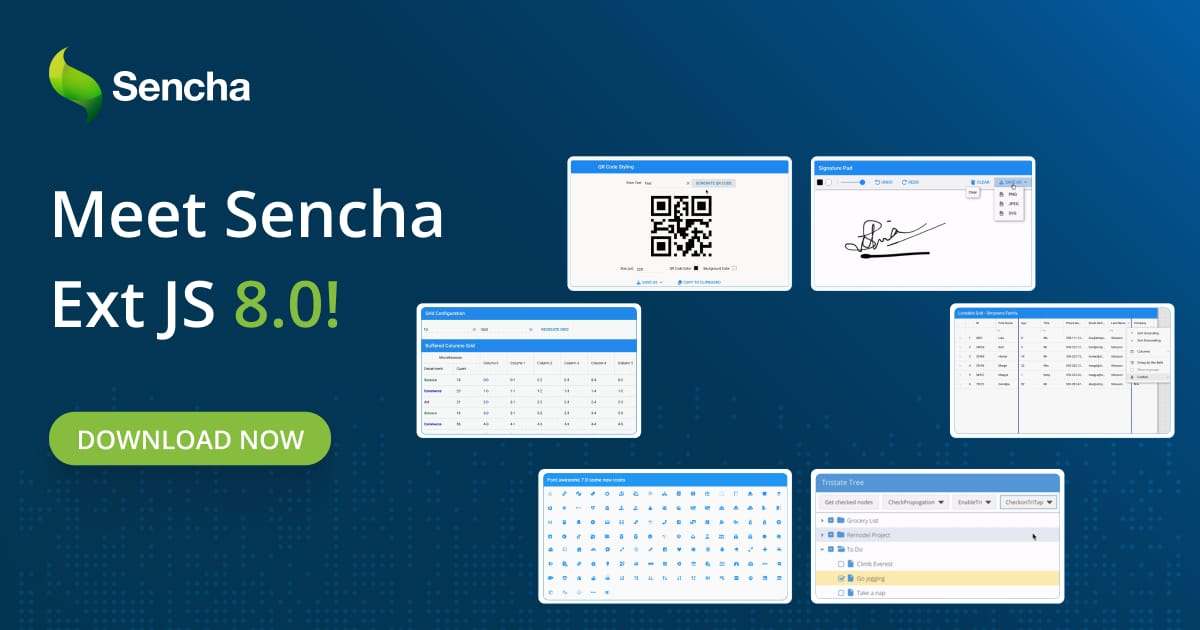
Instead of relying on multiple third-party tools, Ext JS 8.0 provides a complete, unified framework with enterprise-grade components built right in.What’s Included?
Digital Signature Pad
QR Code Reader & Generator
Advanced Data Grids
Accessibility Features
UI Components with Built-in Icon Support
No extra libraries. No patchwork integrations.
Why This Matters for Developers
By reducing external dependencies, you can:Simplify your application architecture
Avoid integration headaches
Deliver a consistent UI experience
Improve long-term maintainability
In short, you spend less time fixing dependencies and more time building features.
Real-World Example
Think about an enterprise dashboard.
Traditionally, you would integrate:One library for QR scanning
Another for digital signatures
Yet another for data grids
With Ext JS 8.0?
You get everything in one place.
That means faster development, fewer bugs, and a more stable product.Final Thoughts
Frontend complexity isn’t just a developer inconvenience—it’s a business risk.
Ext JS 8.0 tackles this head-on by delivering a fully integrated framework that reduces dependency overload and simplifies enterprise development.
If you're building data-intensive, scalable applications, this shift toward built-in capabilities is not just helpful—it’s necessary.