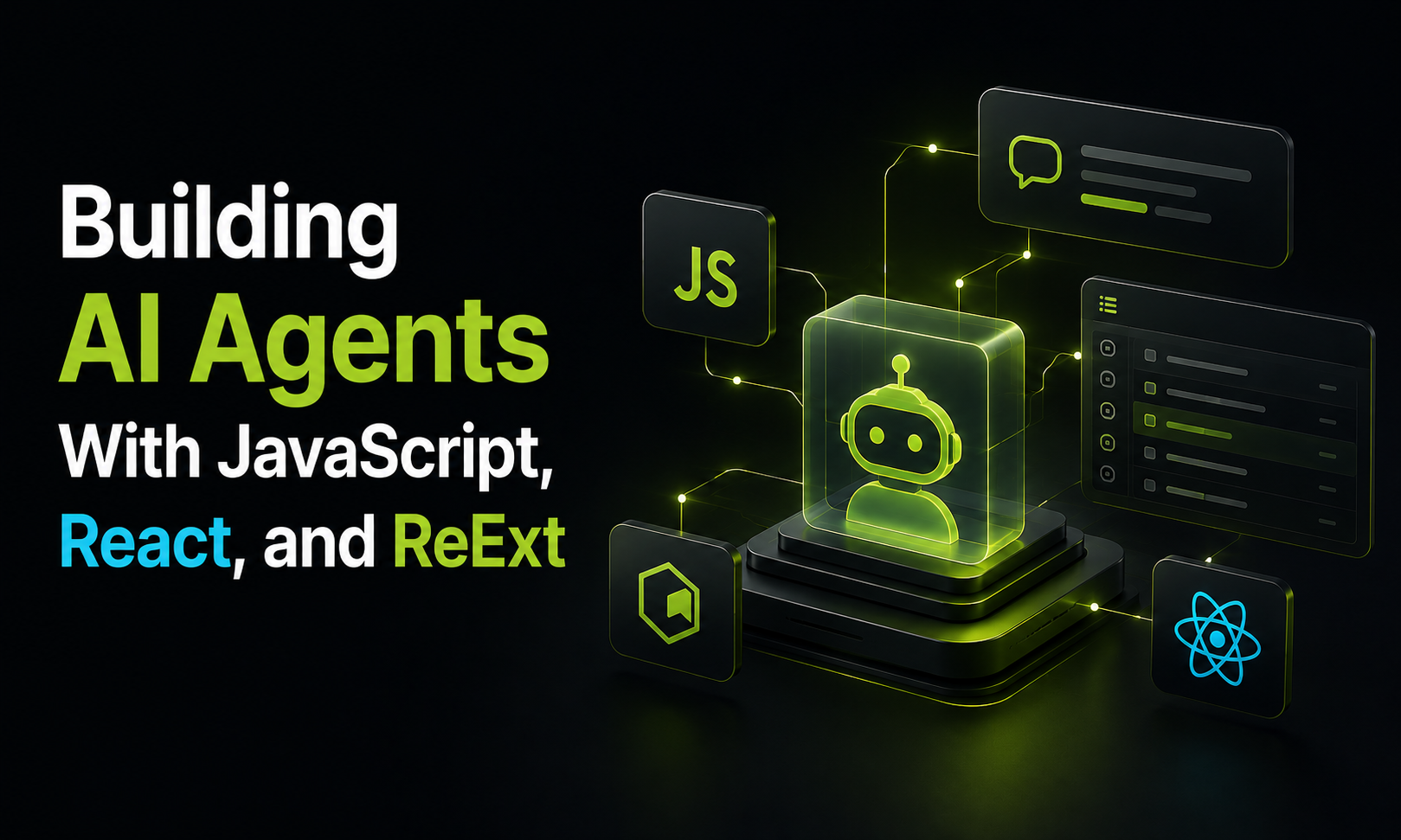
Building AI Agents With JavaScript, React, and ReExt
The JavaScript ecosystem has been talking about AI integration for two years.
Most of that conversation has been about the same thing — how to connect a language model API to a JavaScript application, how to stream responses into a UI, how to build a chat interface that feels responsive and modern.
These are real problems worth solving. But they are not the problem that enterprise JavaScript teams are working through right now.
The problem enterprise JavaScript teams are working through right now is how to build AI agents — systems that do not just respond to queries but reason about goals, use tools to take actions, run multi-step workflows, and operate within the governance and performance constraints that enterprise environments enforce.
What an AI Agent Is — and Why It Matters for Enterprise JavaScript
An AI agent is a system in which a language model is used not just to generate text but to reason about a goal and decide what actions to take toward achieving it.
The actions are taken through tools — functions the agent can call to interact with external systems. A database query. An API call. A document retrieval. A data transformation. Another model call for evaluation or summarization.
For enterprise JavaScript developers, this creates a specific set of engineering challenges that a simple API integration does not. The tools the agent uses are enterprise systems that need to remain performant and reliable regardless of the AI layer operating on top of them.
Why the JavaScript, React, and ReExt Combination
JavaScript provides the runtime environment for the agent core — the reasoning loop, the tool definitions, the orchestration logic.
React provides the interface layer — the component architecture and state management that make it possible to build the complex, interactive interfaces that enterprise AI agents require.
ReExt provides what React's ecosystem alone does not consistently deliver for enterprise data applications — the data grid performance, the charting capability, the tree panel structure, and the layout system that enterprise AI agent interfaces require when they need to surface and interact with data at scale.
The Architecture in Practice
The Agent Core
The reasoning loop where the language model operates. The model receives a goal, evaluates available tools, selects a tool, calls it, receives the result, evaluates the result, and decides what to do next. Every decision, every tool call, and every result must be logged for enterprise audit requirements.
The Tool Layer
The functions the agent calls to interact with enterprise systems. Each tool is a JavaScript function with a clear name, a description the model can parse, and defined input and output schemas. Tool design is where most enterprise AI agent implementations encounter their first significant challenges.
The Interface Layer
Where React and ReExt work together to surface agent outputs in a form that enterprise users can actually work with. For agents that classify, score, or rank data, the ReExt DataGrid is often the most important component — providing rendering performance for large result sets, filtering and sorting capabilities, and cell editing support for human review workflows.
What Production Enterprise AI Agents Actually Require
The distance between a prototype AI agent and a production enterprise AI agent is not the capability of the underlying model. It is the engineering that surrounds it.
Production enterprise AI agents require logging that captures every tool call, every model decision, and every output in a format that satisfies audit requirements. They require error handling that degrades gracefully when model outputs are unexpected. They require rate limiting and cost management. They require human review workflows.
These requirements are not features that get added after the prototype is validated. They are architectural decisions that need to be made before the first line of agent code is written.
Where to Go Deeper on This Topic
Marc Gusmano, Sales Engineer at Sencha, presents a dedicated session on building custom AI agents with JavaScript, React, and ReExt at JS Days 2026 — Sencha's free virtual JavaScript conference taking place September 16–17, 2026.
Registration is free at jsdays.io.